
Overview
On Monday 2 November, crude oil had its worst session in months. December WTI fell $7.66, or 7.36%, to settle at $96.46, and January Brent dropped $8.66, or 7.63%, to $104.77, as Iran and Qatar resumed talks and Washington again signalled a preference for negotiation over escalation. European travel and leisure shares jumped on the news. For anyone managing an airline fuel book, the relief was largely theoretical: the barrel that goes into a wing was still trading near $190, and the margin between that barrel and the crude it came from was still roughly three times its historical norm.
That divergence — cheapening crude, stubbornly expensive kerosene — defines the winter 2026-27 market. IATA puts the global average jet fuel price at $190.18 a barrel in the week to 9 October, up 111% year on year. Its June outlook had 2026 jet fuel averaging $152 a barrel, a $350 billion fuel bill, fuel at 31.4% of operating expenses against 25.4% in 2025, and net profit cut to $23 billion from the $41 billion forecast in December 2025 — a 2.0% net margin.
1. Two prices, one market
The gap has a name, and it is the crack spread. In the third quarter, US Gulf Coast jet fuel averaged $3.83 a gallon, or about $160.90 a barrel, against Brent at $96.30, according to EIA daily spot data. That is a jet-to-Brent spread of roughly $64.60 a barrel, against about $20.10 a year earlier. Jet rose 81% year on year in the period while Brent rose about 40%: an airline that hedged only crude captured less than half of its own cost increase.
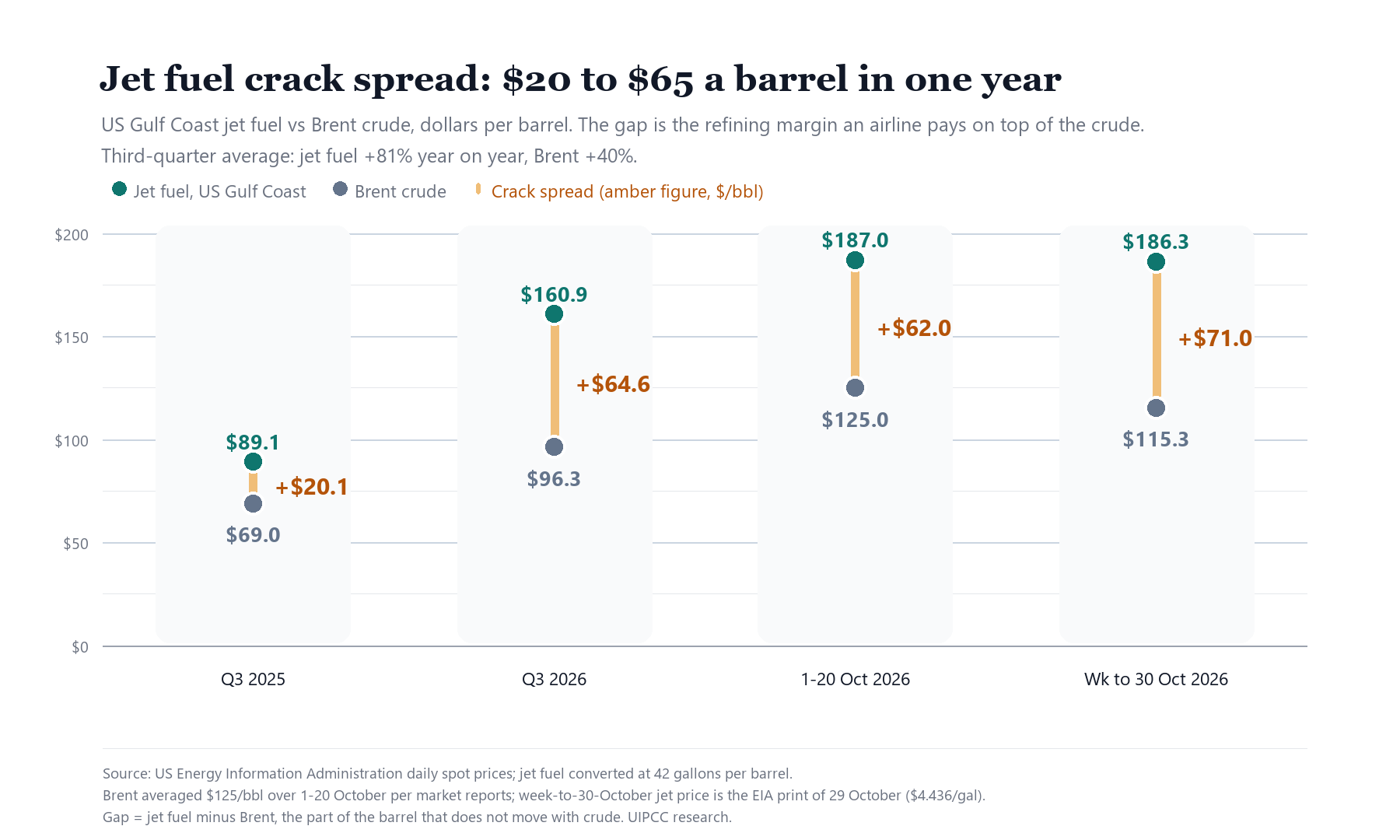
The jet-to-Brent crack spread, dollars per barrel. The amber figure is the refining margin an airline pays on top of the crude; the vertical bar is that margin. Source: US EIA daily spot prices.
October widened the crude leg without closing the product leg. Brent averaged $125 a barrel through 20 October while Gulf jet averaged $187, leaving the spread near $62 — narrower than in the third quarter, still extraordinary. When crude falls 8% in a day from a $113 base, the spread does most of the work: a $9 drop in Brent moves a $187 barrel of jet fuel by less than 5%. The constraints behind that spread — restricted Hormuz flows since late February, curtailed Middle East refining, a Russian jet fuel export ban extended into late November, repeated strikes on Russian refining capacity — are not resolved by a diplomatic communique.
2. What airlines paid, and what they pay next
Third-quarter results show pass-through working, but only partially. The four largest US carriers paid $3.61 to $3.92 a gallon, roughly 60% to 63% more than a year earlier. United reported about $18 billion of revenue and adjusted earnings of $2.54 a share — the bottom of its July range — and recovered only 72% of its extra fuel cost through revenue. Its rule of thumb: one cent on the gallon is worth about 2.5 cents of quarterly EPS.
Fourth-quarter guidance is where the squeeze becomes explicit, because carriers are guiding on fuel dearer than the third quarter, not cheaper:
| Carrier | Q3 2026 fuel paid | Q4 2026 guidance | Q4 read-across |
|---|---|---|---|
| Delta Air Lines | $3.61/gal | ~$4.25/gal | Monroe refinery worth ~40c/gal benefit |
| American Airlines | $3.85/gal | ~$4.70/gal | ~$2.8bn more fuel cost year on year; guides to adjusted loss of $0.50-$1.10/share |
| Southwest Airlines | $3.92/gal | ~$4.55/gal | Unit revenue guided up 19%-21% |
| United Airlines | $3.90/gal | ~$4.80/gal | Assumes $0.45/gal above consensus, worth ~$1.00 of EPS |
The asymmetry matters. Delta’s only structural protection is ownership of the Monroe Energy refinery, which is not a crude hedge but a claim on the refining margin: worth 13 cents a gallon in the third quarter, guided at about 40 cents in the fourth — 8.6% of a $4.65 gallon, against 1.7% in 2025. It is a convex hedge that pays more as conditions worsen, and Delta still expects roughly $4.5 billion of full-year pre-tax profit after a $6 billion fuel cost increase. American, with no such asset, is guiding into a loss while adding 5.5% to 6.5% more seats.
3. The hedging divide
Europe’s spot price is the highest of any major region — IATA put Europe and CIS at $202.61 a barrel in the week to 9 October, up 122% year on year, against $192.64 in North America — but Europe’s paid price is often lower, because European carriers still hedge. Ryanair locked a large share of its 2026 requirement near $67 a barrel early in the year. Wizz Air covered roughly 85% of near-term needs at about $800 a tonne against spot near $1,500. Lufthansa has historically covered 77% to 86% of the current year; Air France-KLM and IAG sit in the 60% to 80% range.
Icelandair shows the mechanic cleanly. Hedges worth about ISK 3.5 billion cut what would have been a $41.3 million operating profit hit to $12.9 million; fuel costs rose 11% while global prices more than doubled. But look at the forward book: 46% of third-quarter consumption hedged below $700 a tonne, 45% of the fourth quarter at $722, then 24% of the first quarter of 2027 at $900 and 18% of the second at $731. The cheap cover runs out precisely when the market is least forgiving.
US carriers took the opposite bet, abandoning financial hedging after the 2014-2016 collapse; Southwest, the industry’s most famous hedger, exited in 2025. They are fully exposed to spot, and price is their only transmission mechanism. US airfares rose about 23% year on year through September, per Reuters, even as TSA throughput fell 2.9% in the quarter. Fewer passengers paying much more is the signature of a capacity-disciplined, fuel-shocked market — and it cannot be repeated indefinitely.
4. Asia’s cost shock arrives through a different channel
Asian carriers face the same physics and different plumbing. In China the ex-factory price is administratively set and lags import parity. PetroChina raised its November jet fuel settlement price by 983 yuan a tonne from 1 November, taking the tax-inclusive ex-factory price for standard product supplied to China National Aviation Fuel and its downstream units to 9,869 yuan a tonne — a single-step increase of roughly 11%, landing after a year in which IATA measured a 132% local-currency increase between April 2025 and the April 2026 peak. Japan (173%) and India (170%) were hit harder once currency was included.
China’s response has been to let the surplus out. August jet fuel exports reached 2.4211 million tonnes, up 97.67% month on month and 34.51% year on year, as domestic output rose 24.33% to 5.87 million tonnes. January-to-August exports were still 19.31% below the prior year at 11.0912 million tonnes, and imports collapsed 71.08% to 68,200 tonnes — evidence of how thoroughly the domestic balance has flipped. Hong Kong took 512,400 tonnes in August, Malaysia 310,500 and the United States 295,900, the latter two reflecting arbitrage Asian refiners could not ignore.
Beijing’s policy valve has turned both ways. The third clean-product export quota of the year was 4.55 million tonnes against roughly 8.4 million a year earlier, with volumes reviewed monthly since the Hormuz disruption; a fourth batch of close to 4 million tonnes in late October took the full-year total to about 40 million tonnes, flat on 2025. The marginal jet barrel clearing Asia in the fourth quarter is therefore likely to be Chinese — supportive for the region’s airlines, mildly bearish for the Singapore kerosene spread.
5. The winter test
Three variables decide whether the fourth quarter is merely expensive or genuinely loss-making.
First, the spread. With an estimated 5 million barrels a day of refining capacity disrupted globally, the conversion step, not the crude, is the scarce asset. Jet fuel is a distillate cousin of diesel and inherits the same bottleneck; diesel has printed records while crude oscillated. Further strikes on Russian or Gulf refining widen the spread faster than cheaper crude can offset.
Second, the pass-through ceiling. United recovered 72% of incremental fuel cost in the third quarter. Delta’s fourth-quarter revenue guide of about 20% growth, and American’s 19.5% to 22.5%, assume fares hold. October US inflation data on 10 November is the next checkpoint: the airline fare index has risen from September to October in each of the past nine years, by at least 1.3%, and a weak print removes the one lever carriers have left.
Third, geopolitics. The 2 November selloff priced a probability of de-escalation, not the fact of it. Hormuz remains restricted, tankers are still being struck, and the Russian ban runs into late November. Re-escalation restores the premium within a session; a genuine reopening would compress it — but the crude leg first and the crack second, the wrong order for anyone needing kerosene next month.
Conclusion
For two years the industry’s fuel debate was about the price of oil. In 2026 it is about the price of the refinery step — harder to hedge, harder to forecast, harder to pass on. IATA’s arithmetic is plain: a $350 billion fuel bill at 31.4% of operating costs against a 2.0% net margin leaves about $23 billion of profit between the industry and a return to losses.
The crude crash was welcome and may have marked the top of the geopolitical premium. But a jet fuel market at $190 with a $62 to $65 crack has not normalised. Until the refining and shipping constraints behind that spread are physically resolved — not negotiated, resolved — airline cost curves stay where they are and winter fares stay firm. Traders should watch the spread, not the headline; carriers should watch hedge expiry dates, not surcharges; and anyone buying forward kerosene for the first quarter of 2027 should assume the cheap cover their counterparties bought in the spring is no longer available at any price.